

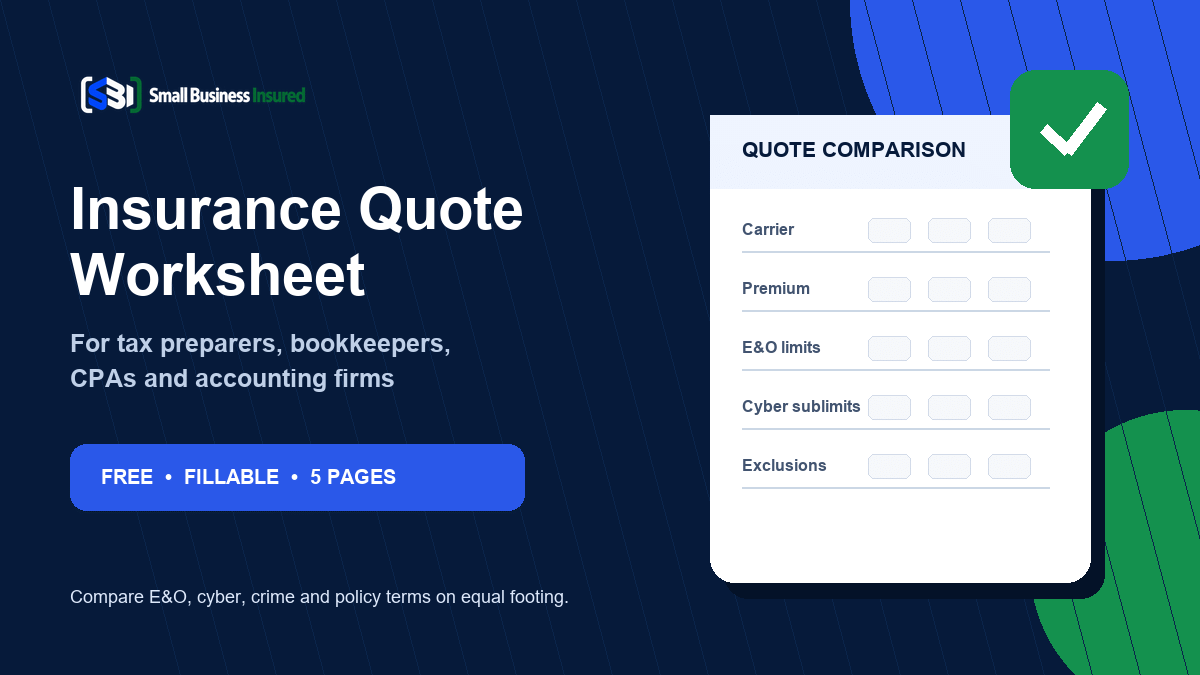
Free fillable PDF • Last reviewed October 7, 2026 • U.S. practices
Compare professional liability, cyber, crime and business insurance quotes without letting a low premium hide a weaker policy.
The Tax & Accounting Practice Insurance Quote Worksheet is a carrier-neutral planning tool for tax preparers, bookkeepers, CPAs and small accounting firms. It helps you organize the information underwriters request and compare up to three proposals on the same terms.
Independent and practical: the worksheet does not rank carriers or recommend a policy. It shows the terms that deserve a written answer before you buy or renew coverage.
What the worksheet covers
Your practice profile
- Revenue, staff and client concentration
- Tax, bookkeeping, payroll, audit and advisory work
- Client-funds, remote-work and contractor exposures
Policy terms
- Limits, deductibles and retroactive dates
- Defense-cost and consent-to-settle wording
- Cyber, crime and social-engineering sublimits
Security controls
- WISP, MFA, backups and endpoint security
- Vendor, training and incident-response controls
- Evidence to keep for underwriting and renewal
Why equal limits do not mean equal protection
Two quotes can display the same limit and still respond very differently. Defense costs may erode the limit. A retroactive date may leave earlier work unprotected. The definition of professional services may omit payroll, advisory, fiduciary or outsourced work. Cyber and social-engineering coverage may be excluded, endorsed or capped by a much smaller sublimit.
| Term to compare | Why it matters | Question to ask |
|---|---|---|
| Covered professional services | Determines which work is within the policy’s scope. | Does the definition include every service my firm currently performs? |
| Retroactive date | May limit coverage for work completed before a stated date. | Will this proposal preserve my existing prior-acts protection? |
| Defense costs | Legal expenses may reduce the amount left for settlement or damages. | Are defense costs inside or outside the limit? |
| Consent to settle | Your decision to reject a settlement can affect what the insurer later pays. | Is there a hammer clause, and how does it work? |
| Cyber and crime | Data events and fraudulent transfers may fall outside professional liability. | Which events are covered, excluded or subject to a sublimit? |
How to use the worksheet
- Complete the practice profile. Use current figures and describe every service, including seasonal or outsourced work.
- Choose the coverage to compare. Professional liability, cyber, crime and general liability solve different problems.
- Record your controls accurately. Do not claim a safeguard is implemented if it is incomplete or inconsistently used.
- Copy terms from the complete proposal. Use the declarations, forms and endorsements rather than a sales summary alone.
- Resolve every material difference in writing. Keep the answers with the application and final policy.
Continue with the guide for your practice
- Tax preparer errors and omissions insurance
- Bookkeeper insurance coverage and requirements
- CPA professional liability insurance
- Professional liability insurance for accountants
- Tax preparer WISP requirements checklist
Frequently asked questions
Is this an insurance application?
No. It is a preparation and comparison tool. Complete the carrier’s or broker’s application separately and answer every underwriting question accurately.
Can I compare professional liability and cyber insurance as one policy?
They address different exposures. Some packages or endorsements combine elements, but the limits, exclusions and response services still need to be compared separately.
Why does the worksheet ask about a WISP and security controls?
Security controls can affect cyber-insurance eligibility, pricing, exclusions and sublimits. For tax professionals, a written information security plan is also an important part of safeguarding taxpayer information. See our WISP requirements guide for the compliance context.
Editorial note: This resource is general educational information for U.S. businesses. It is not a recommendation of any insurer or policy and does not replace advice from a licensed insurance professional, attorney, tax adviser or cybersecurity professional. Policy wording, exclusions, limits, eligibility and pricing vary.